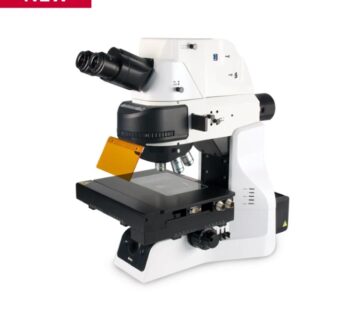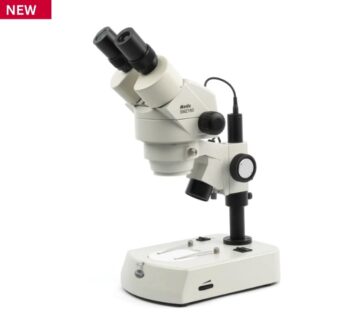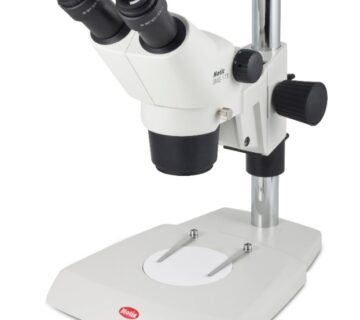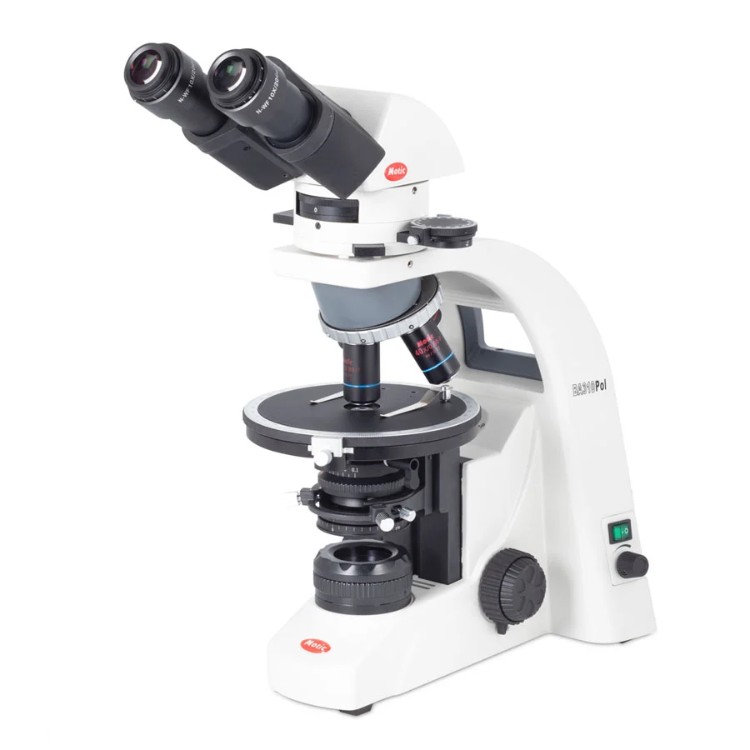
Motic BA310POL & Panthera TEC POL Geology and Petrography Polarizing Microscope
Strain-Free CCIS® Polarizing Microscope with 360° Rotary Stage & Bertrand Lens for Petrography & Material Science
The Motic BA310POL (and next-generation coded Panthera TEC POL series) is a professional polarizing microscope engineered for birefringence analysis in geology, mineralogy, petrography, polymer science, forensics, and clinical gout crystal diagnostics. Equipped with Strain-Free CCIS® EC Plan P objectives, a precision 360° ball-bearing rotary stage, and a focusable Bertrand lens module, it ensures high extinction performance in both orthoscopic and conoscopic observations.
Key Features
- Strain-Free CCIS® EC Plan P (4X, 10X, 20X, 40X, 60X) polarizing objectives mounted on an individually centerable nosepiece
- High-precision Ø160 mm 360° rotatable ball-bearing stage with 1° increments, 0.1° Vernier scale, and 45° click-stops
- Intermediate tube housing a 360° rotatable analyzer and focusable/centerable Bertrand lens for conoscopy
- Standard DIN slot accepting First-Order Red (λ) tint plate, 1/4 Lambda (λ/4) retardation plate, and Quartz Wedge (I–IV)
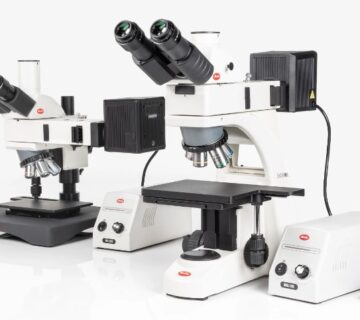
- Available in transmitted-only or combined Transmitted + Incident (Epi-Polarizing) configurations for opaque ore minerals
| Parameter / Component | Specification |
|---|---|
| Models | BA310POL (Transmitted / Epi-Pol) & Panthera TEC POL (LightTracer™ Coded Polarizing) |
| Optical System | Strain-Free CCIS® Colour Corrected Infinity Optical System |
| Eyepieces | N-WF 10X / 20 mm widefield with crosshair reticle |
| Nosepiece | Quadruple individually centerable nosepiece (Quintuple coded on Panthera TEC POL) |
| Objectives | CCIS® Strain-Free EC Plan P 4X, 10X, 20X, 40X/S, 60X/S |
| Rotary Stage | Ø160 mm 360° rotatable stage with 0.1° Vernier reading and 45° click-stop locks |
| Intermediate Tube | 360° Analyzer, focusable Bertrand Lens, and DIN compensator slot |
| Illumination | Full Koehler 50W Halogen or 3W LED transmitted light + optional 50W Epi-Illuminator |
- Geology, mineralogy, rock thin-section petrography, and ore microscopy
- Polymer crystallization, synthetic fibers, pharmaceuticals (API polymorphism), and liquid crystals
- Clinical rheumatology (synovial fluid monosodium urate / gout crystal identification)
- Asbestos fiber identification, glass/ceramic stress analysis, and forensic science